





16.Preparing For Screwcutting
UNLESS an external thread stands proud of any adjacent features, as on a worm, or an internal one is open each end, as on a nut, some preparation is usually necessary or advisable before screwcutting begins, or sometimes before producing the thread by dies or taps. This is so where an external thread ends at a shoulder, or an internal one at the bottom of a blank hole. In such an event, too, the mating part may have to run right up to the shoulder, or almost to the bottom of the hole which necessarily involves precise clear threads as far as possible, and then clearance so that the threads are free for the components to engage in the manner intended. Without such precision, some unnecessary length would inevitably be incorporated on components, to clear the tailing out of threads at the ends hardly to be regarded as neat compact design.
Preparing For Screwcutting
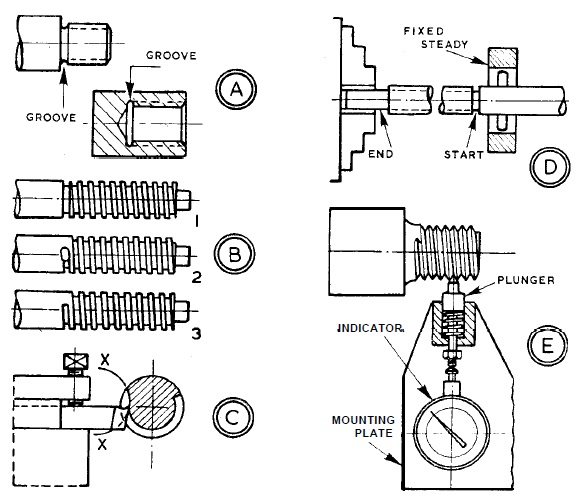
The means of providing clearances at the ends of threads, external and internal, are grooves as at A, usually produced with a round-nosed tool to the depth of the threads, and generally about a pitch wide for V-threads, and somewhat more than half-pitch for square and other threads. In screwcutting, the tool can be run along until it is just clear in the groove; then the leadscrew nut can be disengaged, the feed retracted, and the saddle returned for the next cut all quite deliberately. The alternative, in the absence of a groove, is usually to withdraw the tool quickly towards the end of the thread, perhaps simultaneously disengaging the leadscrew nut success in which obviously requires unusual skill or luck.
For square threads, a groove can be provided as at B1, though it is sometimes undesirable from the local weakening occasioned. An alternative is a hole or slot produced by milling, or by drilling two holes close together, as at B2; and although overcoming the strength problem, care is required to stop the lathe, or retract the tool fairly precisely. Another method leaving a neat run-out end to the thread, as at B3, without the risk involved with tricky tool retraction, is to machine a slot with a keyseat cutter of suitable width and radius, as at C, X-X; then the tool can run clear with time for easy withdrawal. If a V-edged cutter is used, the method is also applicable for neatly finished V-threads. Work too long for the lathe can sometimes be set up as at D, and a start made in cutting where the thread normally ends. Either a turned groove or a keyseat cutter slot can be used to enter the tool, the short milled or drilled groove, B2, not being practicable. Screwcut work to be reset for correction, in the absence of reference diameters, may present a problem in truing which can, however, be overcome as at E. The mounting plate on the sliderest is moved with the V-plunger in the thread, the leadscrew nut engaged and pulling the lathe round by hand, when run-out on the effective diameter can be seen and corrected.
Related Articles
- 41. Self Feeding Facing Tool2016-10-23
- 40. Cutting Discs and Rings2016-10-05
- 39. Milling on Angle Plates2016-09-18
- 38. Accuracy in Details2016-08-23
- 37. Cutting Special Gaskets2016-08-15
- 36. Repair Gear Cutting2016-07-29
