





24.How To Belt Fasteners
FOR light flat belt drives, as may be used in small workshops, commercial types of fastener are usually too large and heavy, fitting badly on the curvature of small pulleys and tending to weaken the belts at positions where they are joined. Generally, better results are obtained-particularly with leather belts-by employing a chamfered and stitched joint or a type of small hinge which can be made to suit any width of belt. If time permits, much of the initial stretch can be taken out of a leather belt by attaching to a beam and hanging a weight on the end for several days. If height is wanting or the belt is long it can pass over the beam, packed to avoid sharp edges, and support a pair of weights. The belt being ready to be joined, pulley adjustment should be let right back and the belt wrapped round and cut so that when joined it will run slightly tight. It is a good plan to lap the belt before cutting, particularly if the pulleys are at fixed centres, placing a small piece of steel plate each side and gripping the joint with self-locking pliers. This should be done in the middle of a run with the tension checked, adjusting as required. Two marks, one each side of the joint at a measured distance, then provide means of verifying the length when the belt is removed to make the joint.
How To Belt Fasteners
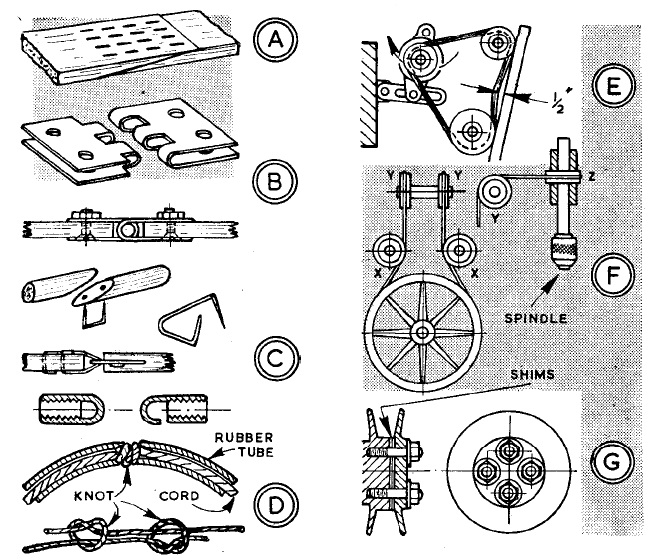
For the type of joint at A, chamfering can be done with a sharp knife, the faces coated with leather adhesive and the joint squeezed in the vice. When adhering it can be stitched with strong thread, lightly scoring the leather with a knife for the stitches to lie flush. For most small belts a hinged fastener, B, is strongly recommended. Construction is by folding sheet steel over a piece of metal slightly thinner than the belt. Gripped in the vice each piece is filed to make lugs fitting into those of the other. Held by pliers hinge pieces and metal are drilled right through and deeply countersunk on the underside-for screw heads to lie flush. Each piece is fitted with two screws, shallow nuts on the outside, and the screws lightly riveted. A piece of round rod, burred each end, makes the hinge pin. One advantage of such a fastener is the belt can be shortened by as little as 1/2 in. A round belt may be joined by butting its ends and driving a type of small staple through. Alternatively, the ends may be chamfered, C(top), coated with adhesive, a staple fitted and the joint bound with thread.
Again, two staples with long legs can be passed through the belt and turned, C(centre.) The end of each staple projects as an eye and the second is fitted linked into the first.
Related Articles
- 41. Self Feeding Facing Tool2016-10-23
- 40. Cutting Discs and Rings2016-10-05
- 39. Milling on Angle Plates2016-09-18
- 38. Accuracy in Details2016-08-23
- 37. Cutting Special Gaskets2016-08-15
- 36. Repair Gear Cutting2016-07-29
