





05.Facing And Countersinking
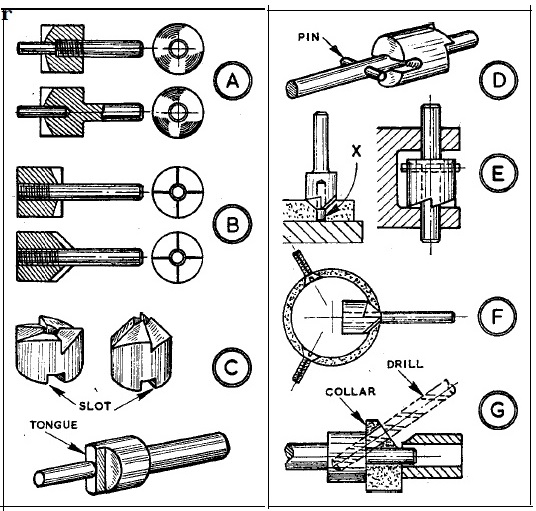
In other than small sizes it is generally advisable for spot or facing cutters to be provided with more than two teeth. For when, say, four or six teeth are operating at once cutting is smoother and there is far less likelihood of chatter or digging in occurring. Of course, two cutting edges are convenient on a spot facing cutter with a spigot or guide to enter the hole in the work, because cutter and guide can be solid, yet the teeth are easily filed. With several teeth, however, it is otherwise, since the spigot offers an obstruction to filing. Hence, constructions are necessary in which cutter and spigot are separate.Two common constructions are as A. In the upper cutter the spigot and cutter shank are one piece, unhardened, the shank being threaded to screw into the cutter, which can be of silver steel, drilled and tapped, provided with filed teeth, then hardened and tempered. In the lower cutter, the spigot is a small separate piece, short, tight-fitting mild-steel or silver-steel rod, unhardened, while the cutter and shank are of silver steel, hardened and tempered. Coned countersinks for screws can be made in either of these ways.
Facing and Contersinking
Another Solution :
On occasion the screw-on cutter provides a solution to the problem of back-facing behind a lug or inside a component where there is obstruction to normal application. The threaded shank is put through the hole, the cutter screwed on to it, and the tool pulled back into the work instead of pushed, as it is rotated in drill or brace. Flat and coned cutters of this type, B, are provided with teeth facing the opposite way to normal, owing to the reverse direction of rotation. The bore for the threaded shank should be plain to just beyond tooth depth, since with the thread to the end of the teeth, there is danger of breakage when the shank pulls in tightly. Pliers may hold the cutter for unscrewing, or spanner flats can be provided.
Tongue and Pin Drives :
A tongue formed on a machined shank or a pin put through a plain shank are alternative means to threads for providing drive to cutters. The latter then have plain holes for pushing tightly on the shanks. On a machined shank, C, the spigot or guide is turned leaving a substantial boss or shoulder. Then the driving tongue is formed by filing down each side beyond the spigot. The backs of the cutters are file-slotted to engage on the tongue.
Related Articles
- 41. Self Feeding Facing Tool2016-10-23
- 40. Cutting Discs and Rings2016-10-05
- 39. Milling on Angle Plates2016-09-18
- 38. Accuracy in Details2016-08-23
- 37. Cutting Special Gaskets2016-08-15
- 36. Repair Gear Cutting2016-07-29
