





06.Pre-loading Bearings
THE principle of torque in tightening is of considerable importance in modern machine and component assemblies employing special ball or taper roller bearings in opposition. The spindles or mandrels of lathes, milling machines and other tools may incorporate such bearings, which are now also standard for pinion shafts and differential carriers in rear axles of cars. The torque required to turn the lathe spindle or the pinion shaft of the axle is often called pre-load, and given in lb. in. It represents largely the load above ordinary friction applied to the bearings in assembly. That is, if the bearings were assembled just without play, they would be subject to friction and require a little torque for turning. But by pre-loading, a noticeable and specified increase in torque is made.
Pre-loading Bearings
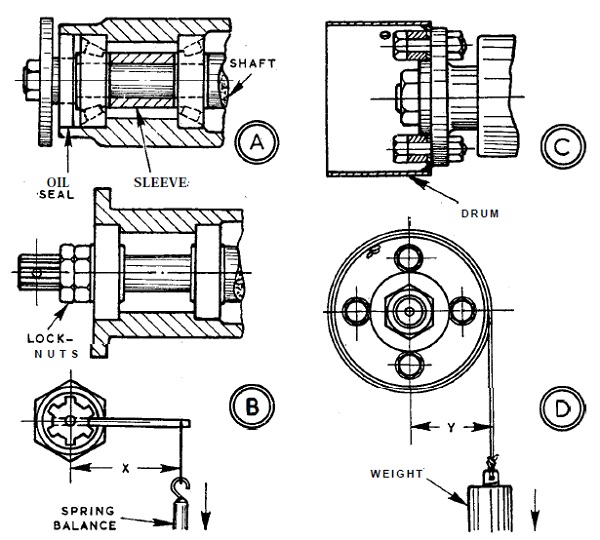
Pre-load, however, can be established in another way. When bearings are assembled just without play, a reference measurement can be made over them endwise. Then it can be arranged to bring them together some small pre-determined amount (say, 0.002 in.), and this is the pre-load, though naturally it has the effect of increasing the torque required to turn the shaft, as the principle is the same as before. Pre-load - as determined by bearing and component manufacturers – needs to be reasonably correct. Otherwise if too heavy, there can be resistance, overheating, and possibly early wear of the bearings; while if not pre-loaded enough, a lathe spindle, for example, would run loose and be subject to chatter, and a car rear axle would whine on drive or over-run.
The bearing outer members are separated by shoulders in the casing, and the inner members are spaced by a sleeve, at the end of which shims normally allow for adjustment. If a test shows insufficient pre-load, the shaft is removed to extract one or more of them. At B bearing outer members are separated as before, but there is no spacing sleeve, and locknuts, usually with washers, admit of applying pre-load. The splined end of the shaft is enclosed, taking the drive through a sleeve from the propeller shaft. Testing of the pre-load can be done with a rod length X through the shaft, pulling on it at right-angles with a spring balance. Length X in inches X balance reading in pounds = load in lb. in. For a shaft with a flange, a sheet metal drum can be made to bolt on as at C, and a cord wrapped round and a weight applied as at D. Then radius Y in inches X weight in pounds = pre-load in lb. in.
Related Articles
- 41. Self Feeding Facing Tool2016-10-23
- 40. Cutting Discs and Rings2016-10-05
- 39. Milling on Angle Plates2016-09-18
- 38. Accuracy in Details2016-08-23
- 37. Cutting Special Gaskets2016-08-15
- 36. Repair Gear Cutting2016-07-29
