





09.How To Do Tailstock Feed Control
While it is often possible to drill holes over-depth from the tailstock, then face the material to length for accuracy, there are occasions when it is desirable or necessary for the drilling itself to be accurately performed. This is true also of counterboring and cutting angular seatings for which fine control of axial movement is essential. For ordinary work, there are various ways and means of exercising depth control. A pencil mark can be put on the drill, or a nick made on it with the corner of a grinding wheel. The extension of the tailstock barrel can be measured – from the end or from a scribed line or centre punch dot or inside calipers or dividers can be used from the tailstock to a mark on the barrel. These suffice for the occasional job on which better than usual accuracy is required, though for a succession of such jobs, it is a convenience for the means of control to be built into the tailstock in the form of a graduated barrel or a micrometer collar. Then not only is there control for precision work, but for ordinary work there is a check on progress with control over depth clearance, so that bar stock is not wasted in facing out unwanted holes in subsequent use. A graduated barrel for a tailstock can be arranged as at A, with spacing of graduations to choice, 1/32 in. being a normal minimum. Reading should be at a pointer rather than at the end of the tailstock, as the advance to a particular graduation can be seen, and there is no temptation to go beyond to be certain of not under-drilling. Such a pointer can be cut from sheet material, bent, drilled and fixed by screws to the tailstock.
How To Do Tailstock Feed Control
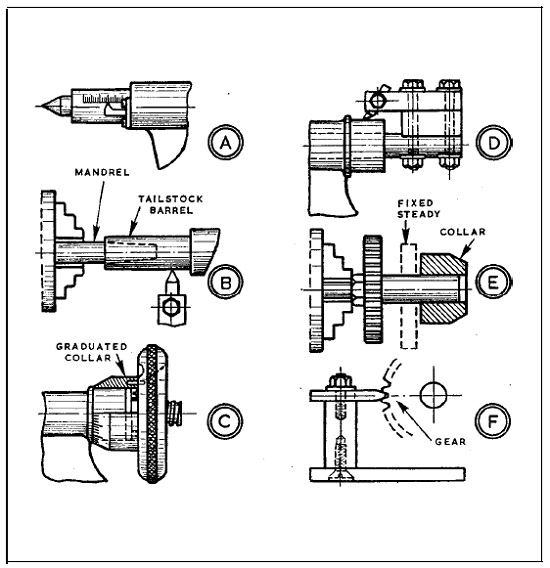
On a screwcutting lathe, the tailstock barrel can be graduated with a set-up as at B. Holding a piece of rod in the chuck, it is machined from the topslide to the taper in the tailstock barrel to form a mandrel on which the barrel can be mounted, leaving clearance from the chuck jaws to work the vee-tool. The handle and key are removed and the barrel allowed to turn in the tailstock body. To mark the base line, the vee-tool is mounted sideways and drawn along the barrel by saddle feed. Then to cut the graduations, with the tool in the normal attitude, the lathe is set to the required thread (say, 32 t.p.i.), and the chuck turned by hand, the tool being fed in at the line and drawn out after a given rotational movement.
A set-up as at D admits of machining the outside of the boss on the tailstock, using a bar through it. Driven from the chuck, this can be flattened at the end for bolting on blocks for the tool, which can be lossened and tapped down for depth of cut. Feed follows from lightly clamping the tailstock to the bed and moving it along with the saddle. The collar can be turned and bored from bar stock or a casting and set up for graduating as at E. For this, its bore can be a force fit on the mandrel which mounts the change gear and is supported by the fixed steady. Later it can be bored to fit the tailstock. Indexing of the gear can be done as at F with a bar bolted to the lathe bed, and a sliding jaw in the teeth of the gear.
Related Articles
- 41. Self Feeding Facing Tool2016-10-23
- 40. Cutting Discs and Rings2016-10-05
- 39. Milling on Angle Plates2016-09-18
- 38. Accuracy in Details2016-08-23
- 37. Cutting Special Gaskets2016-08-15
- 36. Repair Gear Cutting2016-07-29
