





10.Bending And Forming
NUMBEROUS bending and forming operations can be performed in the vice with a hammer and simple mandrels and formers. From round rod can be made hooks, eyes, special staples, chain links; flat sheet or strip serves for light-section angles, channels, boxes and endplates. Small diameters and thin sections can be worked cold but for manipulating large sections using mild steel, a concentrated form of heating is desirable – such as a welding torch – which brings the metal to bright red heat.
Bending And Forming
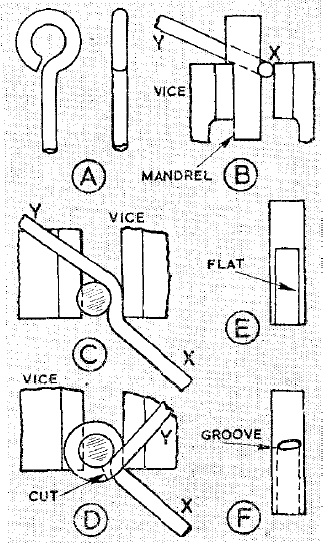
Forming an Eye
From wire, an eye can be turned on a piece of rod A using round-nosed pliers, but diameters of about 1/8 in. or over require the assistance of the vice. A mandrel from a piece of mild steel rod is then utilized; it is gripped in the vice with the rod B. It is convenient for the mandrel to be provided with a flat one side, filed for the vice jaw to grip; on the opposite side there can be a shallow groove at an angle to locate the rod to be used for the eye. This groove can be cut with a small round file. At the second stage of the work C, the end of the rod X is pulled against the edge of the vice to form the neck; the end Y is then carried round the mandrel to form the eye, as at D. Removed from the vice, the rod is tapped down the mandrel, the surplus cut off and the eye straightened by squeezing in the vice. E and F show the flat and the groove on the mandrel, while these may not be absolutely necessary, they do prevent movement while working. If produced cold, the eye will spring open slightly when pressure is released on the end of the rod Y. Consequently, a mandrel somewhat smaller than the finished inside diameter of the eye is required. At red heat, however, close-fitting eyes can be produced from mild steel rod.
How To Bend And Form
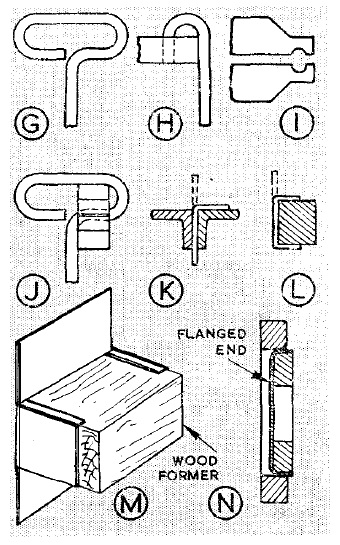
Links and Tee Handles
Chain links and tee handles G can be turned using simple holders. For the first stage H, a hole can be drilled through a piece of bar to take the rod, the end of the hole radiused if necessary. For the second stage, a split holder Z can be made by drilling at the joint of two pieces of bar. Cut to form jaws, they can be gripped about the rod for the second turn of a chain link and utilized as at J for the third turn forming a tee handle.
Channels and Flanges
Short angle lengths in strip metal can be hammered over the vice jaws but for long lengths the strip should be held between two lengths of angle iron K, gripped one end in the vice and the other fixed with a clamp. When an angle is formed, a channel L can be produced over a suitable section piece of bar. For turning thin, ductile sheet metal and strip, hardwood formers of oak or beech should be made to the inside dimensions required, as for the metal box at M. A piece of bar should be clamped on the opposite side of the sheet metal, level with the block where the corner is to be turned- this prevents buckling as the metal is turned over. Round flanged ends, as for small boilers, can be formed from copper discs held between two suitable large washers N and squeezed in a powerful vice. The discs should be annealed before hand; forming can be assisted part of the way through the operation by hammering over the smaller of the washers.
Related Articles
- 41. Self Feeding Facing Tool2016-10-23
- 40. Cutting Discs and Rings2016-10-05
- 39. Milling on Angle Plates2016-09-18
- 38. Accuracy in Details2016-08-23
- 37. Cutting Special Gaskets2016-08-15
- 36. Repair Gear Cutting2016-07-29
