





11.Type Of Bearings
BEARINGS are the means by which shafts are located, enabled to carry loads and transmit power. All machines necessarily employ them and all engineers must design, construction, lubrication, adjustment, etc. Every bearing must perform one of two functions, or a combination of both: (1) carry radial loads, as a journal bearing; (2) take end loads, as a thrust bearing; (3) take both journal and thrust loads. In some applications, usually of a heavy nature, where both kinds of loads are en countered, a bearing of each type (1 and 2) are fitted, though certain types of bearing combine the functions naturally. There are the plain conical and taper types, cup-and-cone ball bearings, standard journal ball bearings (1/3 of journal load as thrust) and taper roller bearings.
Type Of Bearings
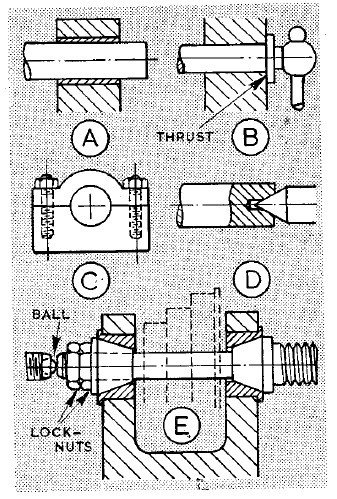
In some instances, where speed of rotation is secondary, no special provision is necessary to take quite heavy thrusts other than a flange on the shaft. The screw of a vice B is a common example. The halved (split-and bolted) bearing, C, whether provided with brasses or a white-metal lining, admits of initial fitting and later adjustment to accommodate wear. In this connection, there may be shims in the joint (steel or brass foil in thicknesses from 0.0015 in. upwards), removal of one or more of which closes the halves to reduce running clearance.
Common Type Of Ball Bearing
Conical Bearings
Between centre turning on a lathe furnishes the most common example of a conical bearing, D, though the same type is used on older lathes for treadle and countershaft bearings. Here the bearing is a hard pad in the end of the shaft, and the pointed adjusting screw is hardened too and fitted with a lock-nut. More substantial bearings of this type are used for the spindles of older and precision lathes E. Locknuts admit of regulating the adjustment for the spindle to turn freely without shake. Solid spindles can have a single ball thrust, though hollow spindles require a thrust in the form of a ring with a number of balls. A separate thrust is essential with this type of bearing for lathe use to prevent seizing.
A Selection of Typical Plain Bearings
Ball Bearings
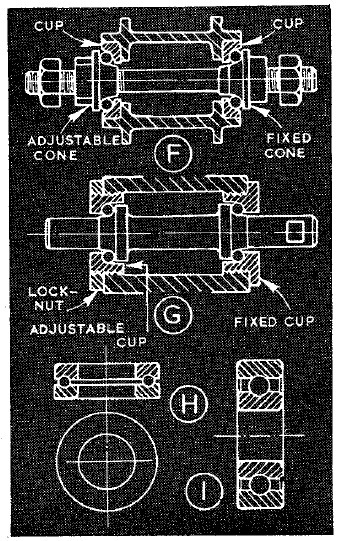
Ball (and roller) bearings possess an advantage over plain types in that rolling is substituted for sliding action-reducing friction and obviating the tendency to seize present on occasion. Disadvantages are all parts of the bearing must be hard and point or line contact involves heavy unit loading. Chipping or scarring of running members can occur. Such bearings, however can carry both journal and thrust loads where neither is too heavy. Common examples are cycle wheel bearings F, and bottom bracket bearings G. On wheel bearings, the cups are pressed in the hubs, one cone is fixed on the spindle and the other adjustable. On bottom bracket bearings, the cones are formed on the spindle, one cup is fixed, and the other adjustable-held by a locknut. Cups are filled with balls, (avoid wedging) and grease to hold them is essential for assembly. Complete new sets of balls must be used, not a mixture of old and new, as old may be undersize. Cycle head races furnish examples of thrust types H, these being adjustable from the top-held by a locknut. The typical ball bearing or race which cannot be dismantled is shown at I. This consists of inner and outer members and a ring of balls located in a cage. A wide range of standard sizes provides for many applications. Outside diameters, bores and widths are held to close dimensions, and housings and shafts are made to light push or driving fits, to obviate rotation other than in the bearing itself.
Related Articles
- 41. Self Feeding Facing Tool2016-10-23
- 40. Cutting Discs and Rings2016-10-05
- 39. Milling on Angle Plates2016-09-18
- 38. Accuracy in Details2016-08-23
- 37. Cutting Special Gaskets2016-08-15
- 36. Repair Gear Cutting2016-07-29
